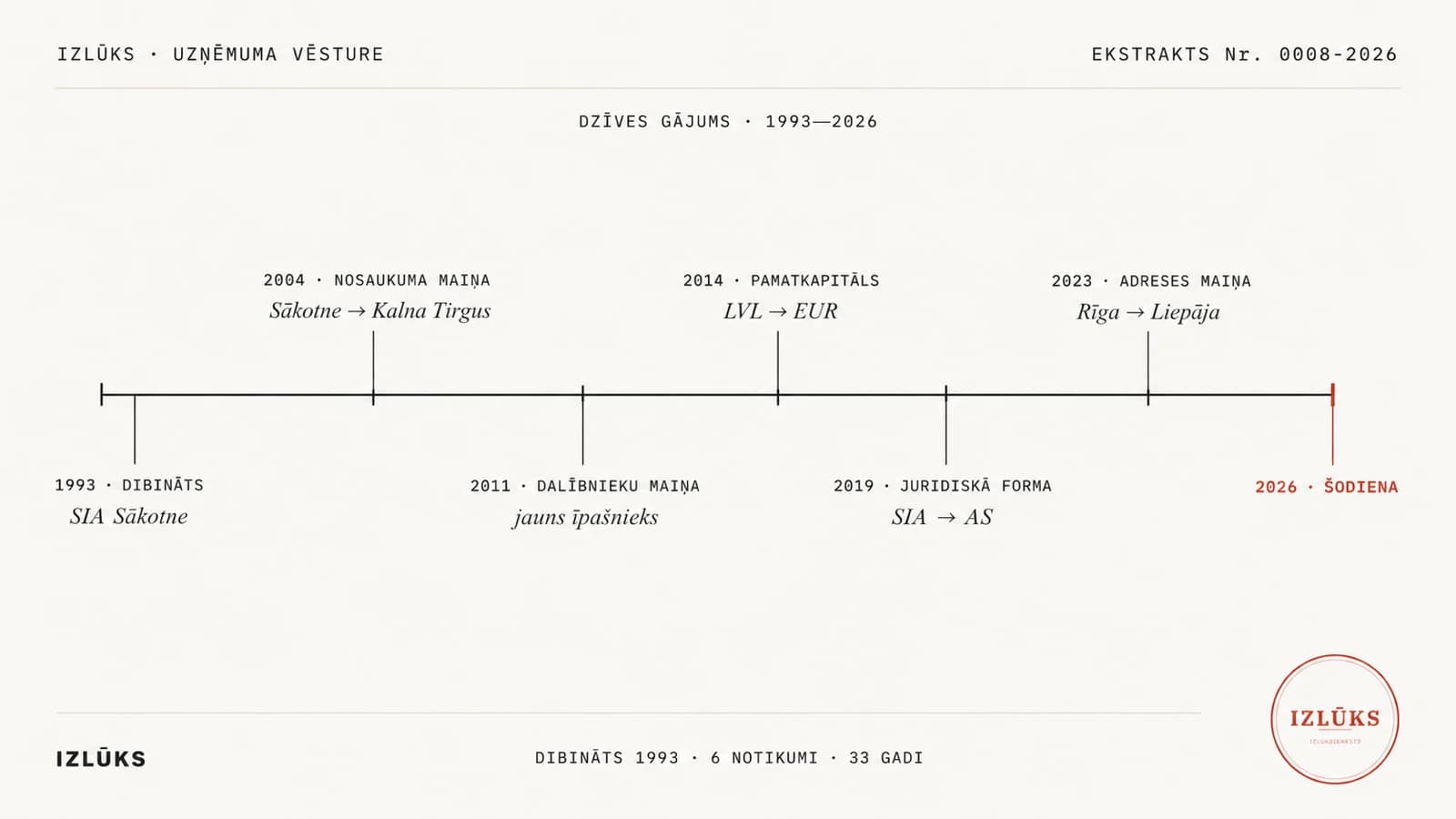
A company profile shows today — owners, board, name, share capital. Its ownership and control history shows how it got there, and you can now view it on the profile and save it as a PDF.
What the register keeps about a company's past
In the business register,1 every record — a shareholder, a board member, a registered address, share capital — carries an effective-from and an effective-to date. When an owner sells a stake or the board changes its chair, the old record does not disappear: it stays marked former, with its own period, while the new one appears marked current. The profile shows only the rows in force today; the history assembles all of them in chronological order, together with everything that once was and has since changed.
What changes the history shows
The history covers seven groups of data. Shareholders — capital-share holders with their share size and period; this shows how ownership passed from one party to another. Officers and representatives — board members, chairs, and others with signing rights, each with the dates of their term. Beneficial owners — the natural persons who control the company, including indirectly, through a chain of ownership (for example, through a holding company in another country), flagged where the owner is a minor.
Share capital — the registered and paid-up capital with each change and its reason; for older companies, this is also where the switch from lats to euro appears. Procuration (commercial power of attorney) and decisive influence — where one company controls another as the dominant party.
The seventh group is corporate events, the company's timeline:
- a change of name,
- a change of registered address,
- a change of legal form, for example from SIA to AS,
- reorganisation — accession, merger, or division,
- liquidation and suspension of activity,
- a change of primary activity (NACE) code.
Every record carries a date or a period, so the history shows not only that a company once had a different name, but for how long.
Why history matters
Compliance and source of wealth. In customer due diligence, what matters is not only who owns a company today, but who owned it at the time of an earlier transaction. Former ownership and the dates of its transfers are a layer today's snapshot does not show.
Counterparty checks. A company that has changed its name, owner, and address several times in a few years is not necessarily suspect, but the sequence is worth seeing. The history shows whether the current name is a new brand or a new owner on an old structure.
Reconstructing an event. A journalist or a lawyer often needs to know who controlled a company on a specific date — the day a contract was signed, or a year before insolvency. Dated periods answer that directly; today's data does not.
How to view and export
The history sits on its own tab in the company profile. Fetching it from the register costs five credits and is available to Agent, Analyst, and Command users; the free Observer tier does not include it.
The fetched history can be saved as a PDF at no charge — a human-readable register extract with all seven sections in chronological order, ready to attach to a due-diligence file or a compliance folder. Personal data in it is partly redacted, and a footer notes that the document is generated from publicly available data and is not legal advice.
Frequently asked questions
How do I find a company's previous names? All former names, with their periods, are in the corporate-events section, alongside the date each one changed.
How do I find who owned a company before? The shareholders section lists every capital-share holder, current and former, with share and period; indirect control is shown by the beneficial-owners section.
How do I see board changes? In the officers section, every board member has a start and end date for their term, so the board's composition can be read at any past point.
How far back does the history go? As far as the register holds dated records — usually to incorporation; for older companies, that includes lats-era capital and addresses.
Is a company's history public? The underlying register data is public and officially published; Izlūks aggregates, links, and arranges it along a timeline.
Does the history show personal data? Persons are identified, but the personal identity code and other sensitive fields are partly redacted. The document is meant for verification, not for distributing personal data.
Today's profile answers who runs a company now. The history answers how it got here — often the more useful of the two in a check.
Notes
Footnotes
-
Ownership and control history is drawn from Latvian company data — the Commercial Register (Uzņēmumu reģistrs, UR) and the State Revenue Service (Valsts ieņēmumu dienests, VID) — and the state data exchange; records are fetched live at the time of the request. Personal data in the output is partly redacted. SIA — sabiedrība ar ierobežotu atbildību, a limited-liability company; AS — akciju sabiedrība, a joint-stock company. ↩