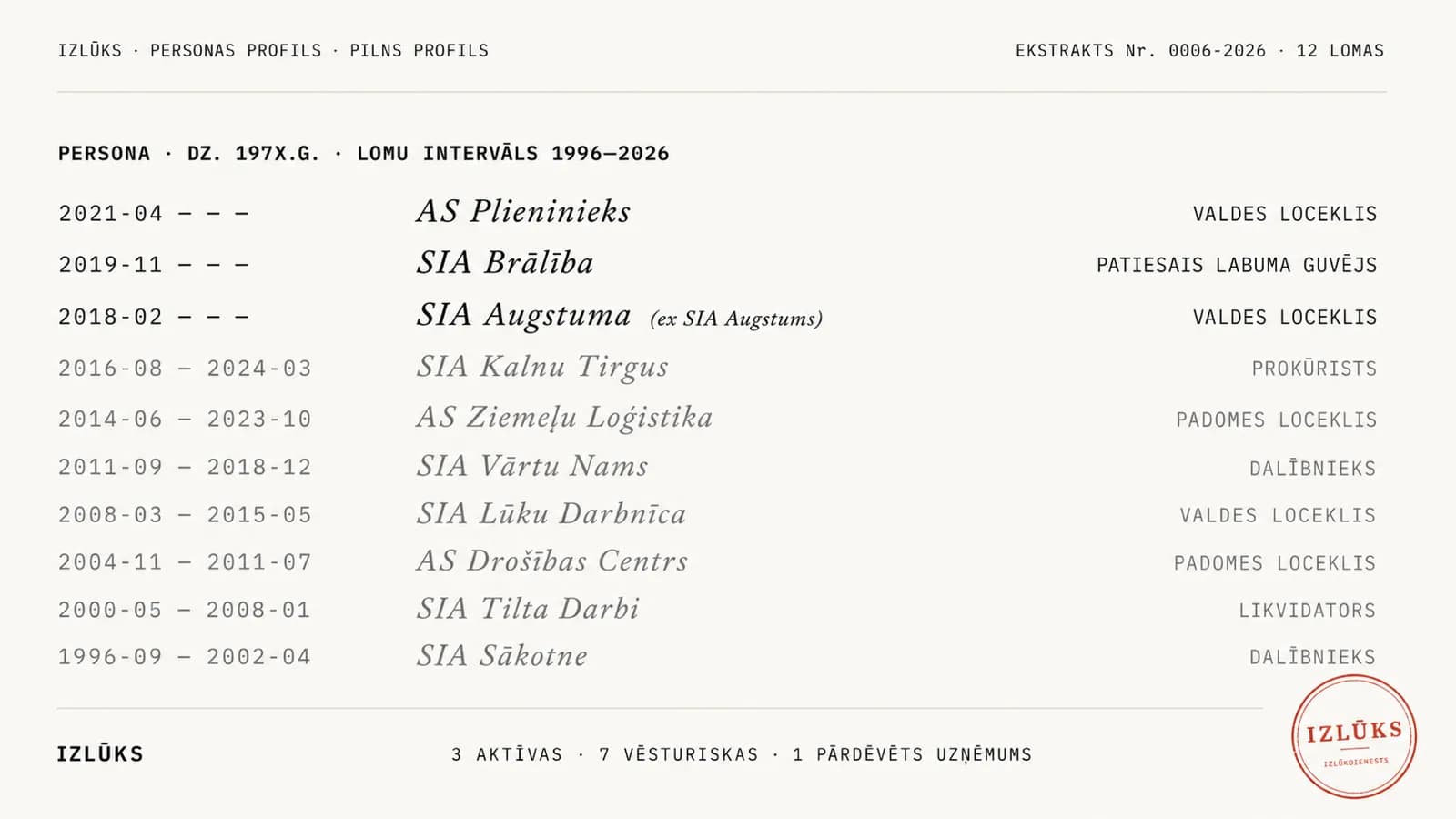
The person profile page now shows the full career trajectory — historical roles with date intervals and the prior names of renamed companies, signing authority, commercial pledges, and spousal property contracts. The full profile is available to Agent and Analyst users, and every section exports to a single PDF or a single CSV.
The free profile page is unchanged. The person search, the basic profile data, the summary tiles, and the registry-roles table — current and historical officers, SIA and AS shareholders, beneficial owners, the sanctions flag — stay in place. The full profile does not overwrite any of this. It appends four new data sections beneath the registry-roles table.
First — historical roles. Historical roles typically outnumber active ones five- to eighteenfold. The section shows full date intervals, the prior names of renamed companies, and roles that are no longer in force. Second — signing authority: representation mode and revoked authorisations. Third — commercial pledges: the person as pledgor, pledgee, and debtor, with active obligations separated from historical ones. Fourth — spousal property contracts: contract number and registration date; the spouse's identity is not included in this section.
Export runs from the profile header, in two languages — LV and EN. The PDF is a human-readable document with six sections, formatted as a registry extract; the CSV is a single table with the unabridged list across all sections, suitable for importing into a spreadsheet or a BI tool. The PDF fits a KYC file or a compliance folder; the CSV fits a pivot table by company or by date interval. Export is available only on the Agent and Analyst tiers; the output document contains the full personal identification code.
Practical scenarios
Client onboarding — verifying signing authority. Onboarding has to establish whether the person signing on a company's behalf is authorised to do so.1 The signing-authority section answers that on one page: INDIVIDUALLY or WITH_AT_LEAST(n), and revoked authorisations are flagged separately — without opening each company's board roster individually.
AML enhanced due diligence — source of wealth. In enhanced due diligence, today's income flow does not answer where the client's total wealth came from.
"The source of wealth refers to the origin of the PEP's entire body of wealth (i.e., total assets). This information will usually give an indication as to the volume of wealth the customer would be expected to have, and a picture of how the PEP acquired such wealth."
— FATF, Guidance on Politically Exposed Persons, 20132
The historical-roles section lays out the career trajectory with full date intervals and the prior names of renamed companies — a data layer that today's officer list does not surface.
PEP monitoring — spousal property as signal. In PEP monitoring, the spouse is one of the first signals. FATF states explicitly that relatives and close associates are used to transfer, retain, or conceal assets, and that the family circle includes spouses.3 The spousal-property contracts section shows the contract number and registration date — enough to flag for further review. The spouse's identity is not included in this section; that requires a separate check.
Counterparty credit risk — pledges from the person side. A small SIA's balance sheet often does not reveal how much its owner has personally pledged or lent elsewhere. The Basel committee emphasises the role of collateral in counterparty credit risk management.4 The commercial-pledges section shows the person as pledgor, pledgee, and debtor in a single table covering both active and historical obligations.
Board and partner assessment — the liquidated-companies ratio. In the European Central Bank's Single Supervisory Mechanism fit-and-proper assessment, a candidate's responsibility for a prior company's insolvency is a reportable and reviewable data element: the questionnaire asks for details of your personal involvement, particularly if you were declared responsible for the insolvency of the entity.5
Investigative journalism — a citable, archivable document. The preservability of the source document is a professional requirement for publication.
"There are two main reasons to archive all of the digital evidence that you use in an investigation: to preserve it in case it is removed from its original source, and to prove to your audience that the material really existed."
— Bellingcat, Open-Source Archiving Handbook, 20186
The person profile PDF carries a generation timestamp, the report's unique identifier, and source references to Latvian company-data registries and sanctions lists.7
The Agent tier is €15 per month with 50 credits; the Analyst tier is €29 per month with 200 credits. PDF and CSV each cost 5 credits; if generation fails, the credits refund automatically.
The person profile page has, until now, shown which companies a person is currently involved in. It now also shows what that person's career has been across the Latvian registries.
Notes
Footnotes
-
Financial Action Task Force (FATF), Consolidated Standards, Recommendation 10 "Customer Due Diligence", 2012 edition (updated 2018). Citation: "Institutions must verify that anyone acting on a customer's behalf is properly authorized and must identify and verify that person's identity." Available at fatf-gafi.org. ↩
-
FATF Guidance, "Politically Exposed Persons (Recommendations 12 and 22)", June 2013. ↩
-
Ibid., FATF 2013 PEP guidance: "Relatives and close associates are often used to transfer, retain, or conceal assets on behalf of a PEP. Family members comprise spouses, children, parents, and siblings…" ↩
-
Basel Committee on Banking Supervision, "Guidelines for Counterparty Credit Risk Management", Bank for International Settlements, 2024. ↩
-
European Central Bank, Single Supervisory Mechanism (SSM), "Fit and Proper Questionnaire", updated December 2021. The relevant section asks for: "details of your personal involvement, particularly if you were declared responsible for the insolvency of the entity." ↩
-
Bellingcat, "How to Archive Open Source Materials", February 2018. ↩
-
Data sources: Latvian company data (Uzņēmumu reģistrs, Valsts ieņēmumu dienests) and the national data-exchange APIs that currently surface historical-role, signing-authority, commercial-pledge, and spousal-property records. Sanctions lists — EU, UN, OFAC, United Kingdom, Latvia. The full-profile sections are in preview status pending a formal agreement on the distribution of this data and an update to the privacy policy. ↩