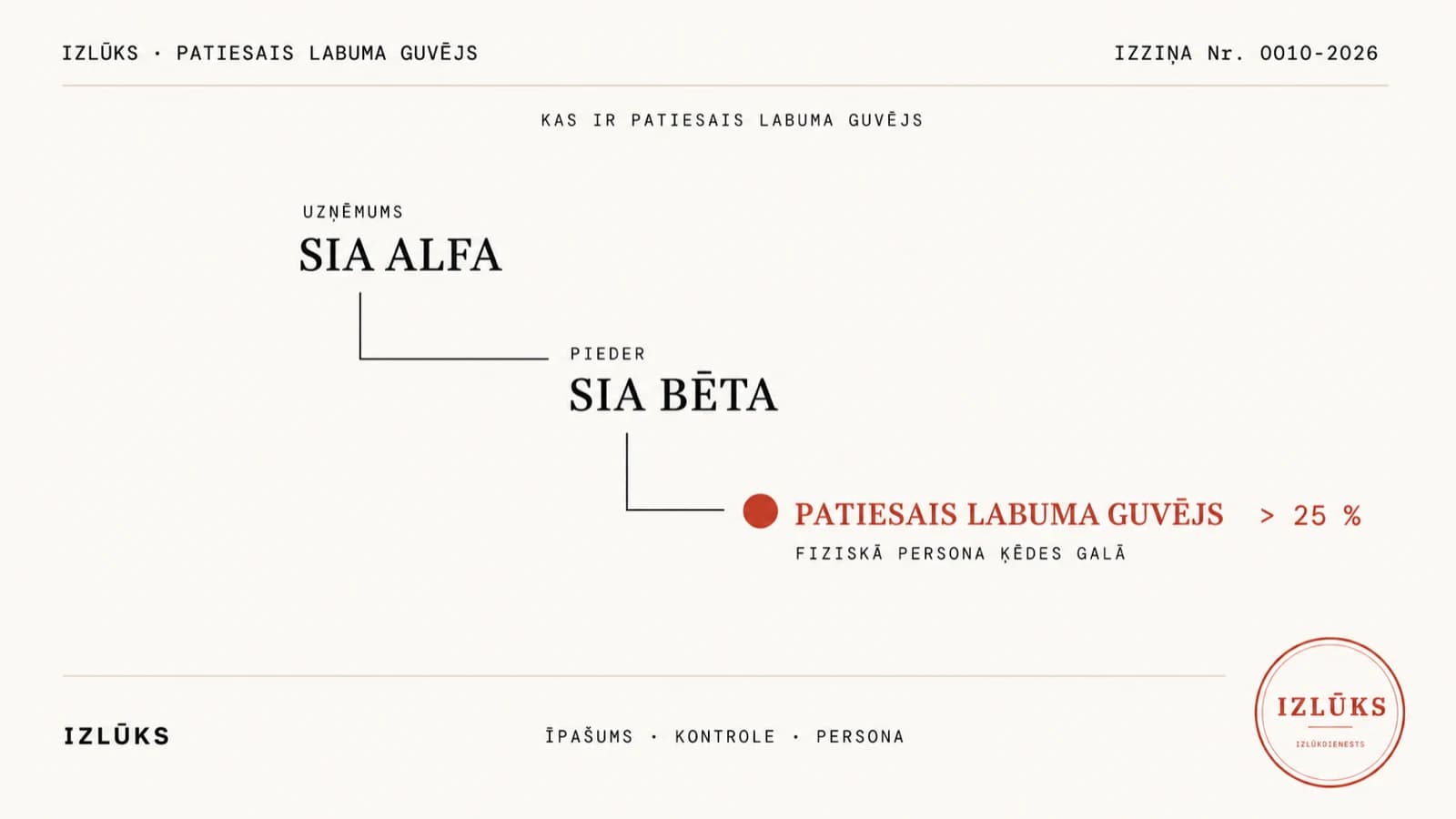
A beneficial owner is the person who really owns or controls a company — even when the formal owner is another company. The register records it once someone crosses the 25 percent threshold or gains control by other means.
A beneficial owner is the natural person who, directly or indirectly, holds more than 25 percent of a company's capital shares or voting rights, or controls the company by other means.1 The definition comes from Latvia's anti-money-laundering law, and its purpose is single: to name the actual person behind a legal entity.
What control means
Twenty-five percent is the lower threshold, not the only test. A natural person who holds more than a quarter of the capital shares or voting rights is a beneficial owner. The holding may be direct — the person is a shareholder — or indirect, through one or more intermediate companies.
Control can also exist without shares. A person who effectively decides a company's actions through a power of attorney, a contract or another arrangement is a beneficial owner too, even with no formal shareholding.2 So a beneficial owner is always a person, never another company: the ownership chain is traced down to a natural person, however long it runs.
A beneficial owner should not be confused with a shareholder or a board member. A shareholder can be another company, and a board member manages without necessarily controlling; only a natural person who crosses the threshold or exercises actual control qualifies. Control is often split: where several corporate shareholders are controlled by the same person, that person can be recognised as the beneficial owner, on the basis of the actual ability to exercise voting rights.
How the register records it
Latvian capital companies (SIA and AS) report their beneficial owner to the business register, the Uzņēmumu reģistrs (UR). The information is filed in the incorporation application, and any change must be reported without delay, within 14 days at the latest.3 The register records not only the person's name and nationality but the basis of control: a direct holding as a shareholder, or indirect control through an intermediary, a power of attorney or a contract. On a company or person profile these details sit alongside the rest of the register record.
With indirect holdings, the chain is what matters. If one company owns another that a natural person controls, the beneficial owner is that person at the end of the chain, not the intermediate company. Latvian company data holds 199,181 beneficial-owner records;4 for some the link to the company is direct, for others it runs through several layers of ownership.
When no beneficial owner can be identified
Not every company has a person above the 25 percent threshold. Where ownership is dispersed and no natural person can be identified as the beneficial owner, the company certifies this in the application, with justification. In that case the person holding the most senior management position — in practice a board member — is treated as the beneficial owner.5
For an analyst this means one thing: the beneficial owner named in the register is not always an owner. An entry showing a board member with no ownership percentage is most likely this default rule, not a real ownership interest. The two are told apart by the basis of control, which the register records next to the person.
Why it matters for due diligence
Identifying the beneficial owner is a mandatory step in customer due diligence. Banks, notaries, accountants and other obliged entities may not enter into a business relationship without first establishing who is actually behind the client.6 The register record is the first point of that check.
In Latvia this data remains publicly available to anyone. After the 2022 judgment of the Court of Justice of the European Union, which struck down general public access to beneficial-owner registers, several EU states restricted access; Latvia concluded there was no basis to change its approach.7 In practice a counterparty's beneficial owner can be checked knowing only the company's name or registration number. A person search also gives the reverse view: one person and the companies in which they are the beneficial owner.
The register shows what a company declared, not the full ownership picture. A real owner is told from a default managing officer by the basis of control — and that is the thing worth reading before drawing a conclusion.
Notes
Footnotes
-
Definition of the beneficial owner and the 25% threshold — Latvia's Law on the Prevention of Money Laundering and Terrorism and Proliferation Financing (in Latvian, Noziedzīgi iegūtu līdzekļu legalizācijas un terorisma un proliferācijas finansēšanas novēršanas likums), Section 1(5). Source: likumi.lv. ↩
-
Forms of control (direct and indirect holding; control by power of attorney, contract or other arrangement) — beneficial-owner guidance of the Latvian Enterprise Register (Uzņēmumu reģistrs). Source: ur.gov.lv. ↩
-
The duty of capital companies (SIA, AS) to report the beneficial owner in the incorporation application and any change without delay, within 14 days at the latest — Enterprise Register (ur.gov.lv); obligation set in the law above, Section 18. ↩
-
Latvian company data holds 199,181 beneficial-owner records; extract 2026-07-02. ↩
-
Action where the beneficial owner cannot be identified, and the presumption of the most senior managing official — beneficial-owner guidance of the Enterprise Register (ur.gov.lv); the anti-money-laundering law above, Section 18. ↩
-
Establishing the beneficial owner as part of customer due diligence by obliged entities — Latvia's anti-money-laundering law (likumi.lv). This article explains the public register and the legal framework; it is not legal advice. ↩
-
Judgment of the Court of Justice of the European Union of 22 November 2022 in joined cases C-37/20 and C-601/20, striking down the AML directive provision on general public access. The Latvian Ministry of Justice concluded that access for anyone should be retained — ur.gov.lv, lvportals.lv. ↩