Over the past 30 days, 403 companies in Latvia were liquidated, while only 23 new insolvency proceedings began. Liquidation is a voluntary closure of a company; insolvency is a court process, governed by the Insolvency Law and recorded in a public register.
Insolvency is a court-recognised state in which a company cannot meet its debt obligations. Legal-entity insolvency proceedings are a set of legal measures under which creditor claims are satisfied from the debtor's assets; the process begins when the court declares it and ends when the court terminates it.1 From start to finish it is governed by the Insolvency Law (Maksātnespējas likums), in force since 1 November 2010.
What the Insolvency Law covers
The Insolvency Law governs three separate processes: legal-entity insolvency, natural-person insolvency, and the legal protection process.2 The legal protection process is the opposite of closure: its aim is to restore the debtor's ability to meet its obligations, with the debtor agreeing a repayment plan with creditors. This article explains the first — company insolvency; natural-person insolvency is a separate subject.
Company insolvency proceedings can be initiated in court either by the debtor itself or by a creditor.3 The reason is usually straightforward: the debts exceed what the company can pay, and the matter is handed to the court so that creditor claims are satisfied in the statutory, supervised order.
The stages of the process
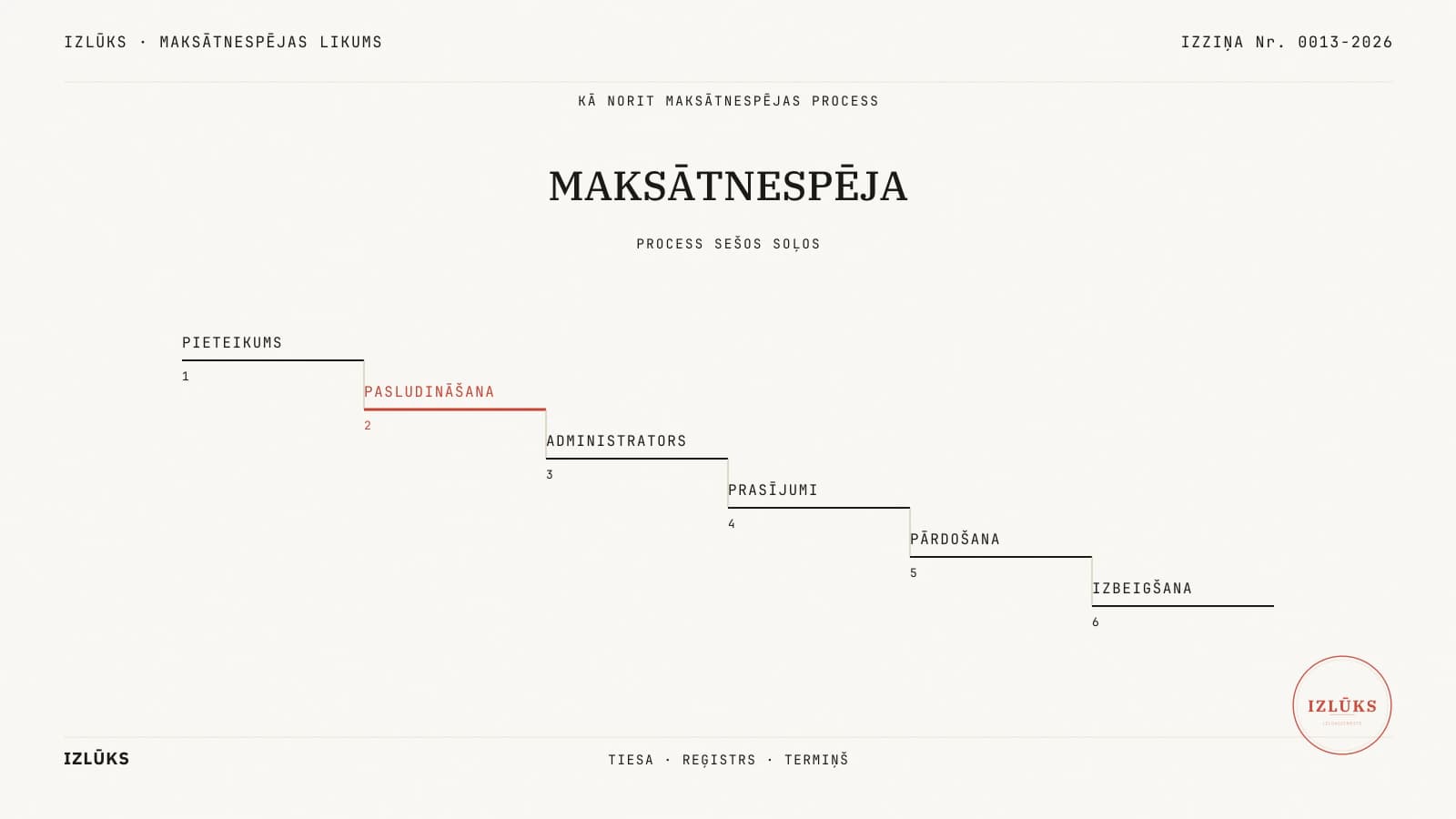
Company insolvency proceedings run through defined stages, each of which is recorded in a public register.4
- Application to court. The debtor or a creditor files an insolvency application.
- Declaration of proceedings. The court declares the insolvency proceedings by ruling; from that moment they are in effect, and the company's previous management loses the right to act on its behalf.
- Appointment of an administrator. The court appoints an insolvency administrator, who takes over management of the company and represents it in the proceedings.5
- Creditor claims. Creditors submit claims to the administrator within one month of the date the declaration is entered in the insolvency register. If missed, a claim may still be submitted within a further six months, but with limited rights.6
- Sale of assets and settlement. The administrator sells the debtor's assets and, from the proceeds, satisfies creditor claims in the order set by law.
- Termination of proceedings. Once claims are satisfied as far as the debtor's assets allow, the court terminates the proceedings. The company is then usually struck from the register.
What the insolvency register shows, and when
Insolvency proceedings are not known only to the parties involved — every step is disclosed in the insolvency register. It is maintained by the Register of Enterprises (Uzņēmumu reģistrs, UR) and is available to everyone free of charge; debtors' and administrators' personal identity codes are not shown in the public entries.7 The register shows the date proceedings were declared, the appointed administrator, creditors' meetings, and termination. The declaration entry also starts the clock on the month within which creditors must submit claims, so the register date is not a formality but the start of a deadline.
Izlūks compiles these entries and shows both the most recent proceedings and their counts over 7, 30, and 365 days. Over the past 30 days, Latvian company data recorded 23 new company insolvency proceedings and 6 legal protection processes.8
Insolvency or liquidation
Liquidation and insolvency can both end with a company being struck from the register, but their starting points are opposite. Liquidation is a voluntary, solvent winding-up under the Commercial Law (Komerclikums): the shareholders decide to close a company that can meet its obligations; a liquidator satisfies creditor claims, which must be filed within three months, and distributes the remaining assets among the shareholders.9 Insolvency starts from the reverse: the company cannot meet its obligations, so a court decides the matter.
The figures show that most company closures are liquidations, not insolvencies: over the past 30 days, 403 companies were liquidated against 23 new insolvency proceedings.10 So in assessing a counterparty, a closed company is not the same as an insolvent one. If a company in liquidation turns out to be insolvent, the liquidation cannot be completed and the matter must be moved to insolvency proceedings.
Company insolvency is a public, dated court fact that can be traced from the declaration of proceedings to their termination. A specific company's insolvency status can be checked by finding it in company search; the exact deadlines and procedure are set by the Insolvency Law.
Notes
Footnotes
-
Legal-entity insolvency proceedings are a set of legal measures under which creditor claims are satisfied from the debtor's assets; they begin on the day the court declares insolvency by ruling and end when the court decides to terminate the proceedings. Article 4 of the Insolvency Law (Maksātnespējas likums). The law was adopted on 26 July 2010 and has been in force since 1 November 2010. Source: likumi.lv. ↩
-
The Insolvency Law governs legal-entity insolvency, natural-person insolvency, and the legal protection process. The legal protection process is a set of measures aimed at restoring the debtor's ability to meet its obligations (Article 3). Source: likumi.lv. ↩
-
An application for legal-entity insolvency proceedings may be filed with the court by the debtor or a creditor; in certain cases, other persons specified by law may do so. Insolvency Law. Source: likumi.lv. ↩
-
The sequence of stages and the transition between them is set by the Insolvency Law; the court decides the declaration and termination of proceedings by ruling (Article 4). Source: likumi.lv. ↩
-
The administrator in legal-entity insolvency proceedings is appointed by the court in the manner set by the Insolvency Law and the Civil Procedure Law. Article 19 of the Insolvency Law. Source: likumi.lv. ↩
-
Creditor claims against the debtor are submitted to the administrator within one month of the date the entry on the declaration of the debtor's insolvency proceedings is made in the insolvency register. If missed, a claim may be submitted within six months of that entry, but no later than the drawing-up of the claim satisfaction plan; after that, claim rights lapse. Article 73 of the Insolvency Law. Source: likumi.lv. ↩
-
The purpose of the insolvency register is to ensure the publicity of insolvency proceedings; the register is available to all free of charge (Article 12 of the Insolvency Law). It is maintained by the Register of Enterprises (Uzņēmumu reģistrs, UR — Latvia's business registry), and its entries carry public credibility. Because public entries can be viewed by anyone without authentication, the personal identity codes of the debtor and administrator are not shown; they are issued on separate request. Sources: likumi.lv, ur.gov.lv. ↩
-
Over the past 30 days (to 2026-07-17), Latvian company data recorded 23 new legal-entity insolvency proceedings and 6 legal protection processes. Izlūks insolvency feed; extract 2026-07-17. ↩
-
Liquidation is the voluntary winding-up of a solvent company under the Commercial Law (Komerclikums): the liquidator recovers debts, satisfies creditor claims — which must be filed within three months of the liquidation notice — and distributes the remaining assets among the shareholders. If the company proves unable to meet its obligations, the liquidation cannot be completed and an insolvency application must be filed. Source: likumi.lv. This article explains the public register and the legal framework; it is not legal advice. ↩
-
Over the past 30 days (to 2026-07-17), Latvian company data recorded 403 company liquidations. Izlūks closed-company feed; extract 2026-07-17. ↩