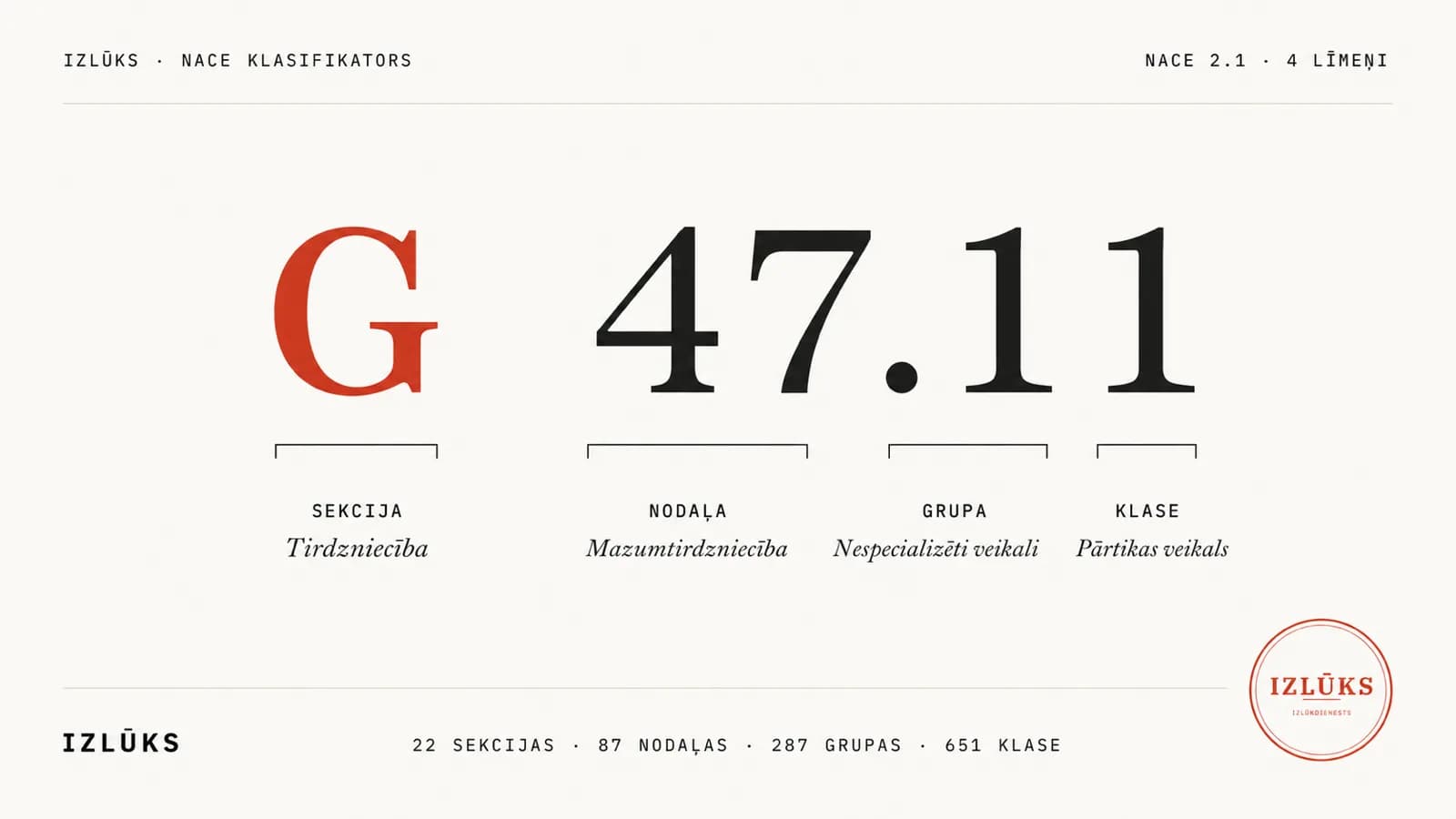
A NACE code is the European Union's classification of economic activity: one letter and four digits that say what a company actually does. It is what lets you compare companies within an industry, and view the industry as a whole.
What a NACE code is
NACE is the acronym of the French Nomenclature statistique des activités économiques dans la Communauté européenne — the statistical classification of economic activities in the European Community. It is maintained by Eurostat and shared across the EU: the same code denotes the same activity in Latvia, Germany or Estonia.1 In Latvian it is also called the saimnieciskās darbības kods or pamatdarbības veids (main-activity type).
A code is not a company's legal form, and not a tax category. A limited-liability company (SIA), a joint-stock company (AS) or a sole trader — that is the form. NACE answers a different question: what the company makes, sells or provides. It is used in national and EU statistics, in tax administration, and for cross-country comparison.
NACE is the EU version of the UN classification ISIC. At the upper levels the two coincide, so Latvian industry data is comparable not only across the EU but more widely.2
How a NACE code is built
A code has four levels, from broadest to narrowest:
- Section — one letter (e.g.
G). - Division — two digits (
47). - Group — three digits with a dot (
47.1). - Class — four digits with a dot (
47.11).
Example: a grocery shop sits in section G (wholesale and retail trade), division 47 (retail trade), group 47.1 (retail sale in non-specialised stores) and class 47.11 (retail sale predominantly of food). The more digits, the narrower the description.
The top level is the section. NACE Rev. 2.1 has 22 of them, A to V. Latvian company data shows 21: section V — extraterritorial organisations — has essentially no commercial companies.
NACE 2.1: what changed in 2025
Until 2024, Latvia and the EU used NACE Rev. 2, in force since 2008. From 2025, official statistics are phasing in NACE Rev. 2.1.4
The main change concerns the digital economy. The former section J — "Information and communication" — was split in two: a new J (publishing, broadcasting and content production) and a new K (telecommunication, computer programming, consulting and information services). Because a section was added, every letter from the former K shifted forward by one — finance moved from K to L, real estate from L to M, and so on to the new V. The number of sections rose from 21 to 22.
At the lower levels the number of divisions fell from 88 to 87, groups rose from 272 to 287, and classes from 615 to 651.4 The practical consequence in Latvia: companies had to review and, where needed, correct their main-activity code.5
How a company gets its NACE code
In Latvia a company declares its main-activity type itself. It is reported to the State Revenue Service (VID) electronically; if the main activity changed in the previous year, the code must be updated by 1 May.6 Where a company carries out several activities, the principal one is whatever made up the largest share of total turnover that year. A company declares a single main-activity code, even though in practice it may operate across several fields.
A second code exists in parallel. The Central Statistical Bureau (CSP) also determines a company's activity type on its own — from statistical surveys, annual reports and other sources — and this determined code may differ from the one declared to VID.7 So the declared code does not always match what a company actually earns from: it can be out of date, or chosen at registration and never changed since.
What a NACE code lets you see
The code turns individual companies into a comparable industry. A few of the views it opens:
For a company's managers — its place in the industry. Once a company can be compared with others in the same section or class, you can see where it stands against the industry's averages: turnover per employee, size, profit margin. Manufacturing (section C) has 11,283 active companies with €13.3bn in turnover and 112,528 employees — about ten per company. In trade (G) the ratio is quite different.
For sales and marketing — market size. NACE lets you count the pool of potential customers. If a product is meant for telecommunications and IT companies, section K has 7,099 active companies; for construction, section F has 11,234. At class level the pool can be narrowed to a specific activity.
For compliance and AML — risk patterns by sector. The rate of closures and insolvencies differs by industry. Of the classified trade companies (G), 3,711 of 28,523 have closed so far; in construction (F), 1,662 of 12,896; in real estate (M), 1,025 of 12,191. The section becomes one of the risk signals.
For investors and analysts — peer comparison. Within a single NACE class, a company can be placed in percentiles by turnover, profit or assets, and its nearest peers by scale identified.
The same code is useful more broadly. For a journalist it helps make sense of an entire sector and its owners; for a policymaker, to see where companies form and where they employ (manufacturing, with comparatively few companies, employs more than 112,000 people); for a job-seeker, which sectors are the largest and where employment is growing.
Frequently asked questions
How do I find a company's NACE code? The declared main-activity code appears in the business register's open data and in commercial data services. The Central Statistical Bureau runs a classifier look-up where you can find a code's meaning and correct your own.
Can a NACE code be changed? Yes. A company reports a change of main activity to VID itself; if the activity changed in the previous year, the code must be updated by 1 May. The Statistical Bureau may also revise the code on its own.
How many NACE codes can one company have? One, for the main activity. A company may carry out several activities, but the principal one — the one with the largest share of turnover — is what gets declared.
How does NACE differ from ISIC? ISIC is the UN's global classification; NACE is its EU version — identical at the upper levels, more detailed at the lower ones. That is what makes Latvian industry data comparable across the EU and more widely.
Is a NACE code mandatory? The main-activity type must be reported to VID, so in practice every economically active company has one. It is used both in statistics and in tax administration.
Because the declared code can lag a company's actual activity, an industry picture can also be built from tax data. In Latvian company data, around 150,000 companies are classified by economic activity using VID tax data for 2022–2024; their breakdown by section and division can be viewed in the industry overview.
Notes
Footnotes
-
NACE — the statistical classification of economic activities in the European Community; maintained by Eurostat. Definition and structure: <a href="https://ec.europa.eu/eurostat/web/nace">ec.europa.eu/eurostat/web/nace</a>. ↩
-
ISIC — the UN's International Standard Industrial Classification, currently Rev. 4. NACE is derived from it and coincides with it at the section and division levels; below that, NACE is more detailed. Eurostat methodology (KS-RA-07-015). ↩
-
Company counts by NACE section in Latvian company data; extract 2026-06-01. "Companies" — entities with a NACE classification (active and closed), classified by economic activity on the basis of VID (State Revenue Service) tax data for 2022–2024; total 149,641. The figure differs from the total number of companies in the register, because not every register entry has a determinable economic activity. Full data set: <a href="/blog/007/data.json">data.json</a>. ↩
-
NACE Rev. 2.1 is established by Commission Delegated Regulation (EU) 2023/137 (adopted 2022-10-10), amending Regulation (EC) No 1893/2006 (NACE Rev. 2, 2006). Used in European statistics from reference year 2025. Category counts: NACE Rev. 2.1 — 22 sections, 87 divisions, 287 groups, 651 classes; NACE Rev. 2 — 21 sections, 88 divisions, 272 groups, 615 classes. Sources: EUR-Lex; Eurostat. ↩ ↩2
-
In Latvia, NACE Rev. 2.1 has been in force since 1 January 2025; during the transition companies must review and correct their main-activity code. Source: Central Statistical Bureau (csp.gov.lv). ↩
-
Reporting of the main-activity type to the State Revenue Service (VID); the duty to update the code by 1 May where the main activity changed in the previous year — law "On Taxes and Duties", Section 15(1), point 15. The main activity is the one with the largest share of total turnover. Sources: VID (vid.gov.lv); lvportals.lv. ↩
-
The Central Statistical Bureau notes that the economic-activity type a company has reported to VID may differ from the one the Bureau determines: it determines the type from statistical surveys, annual reports and other sources. Source: csp.gov.lv. ↩