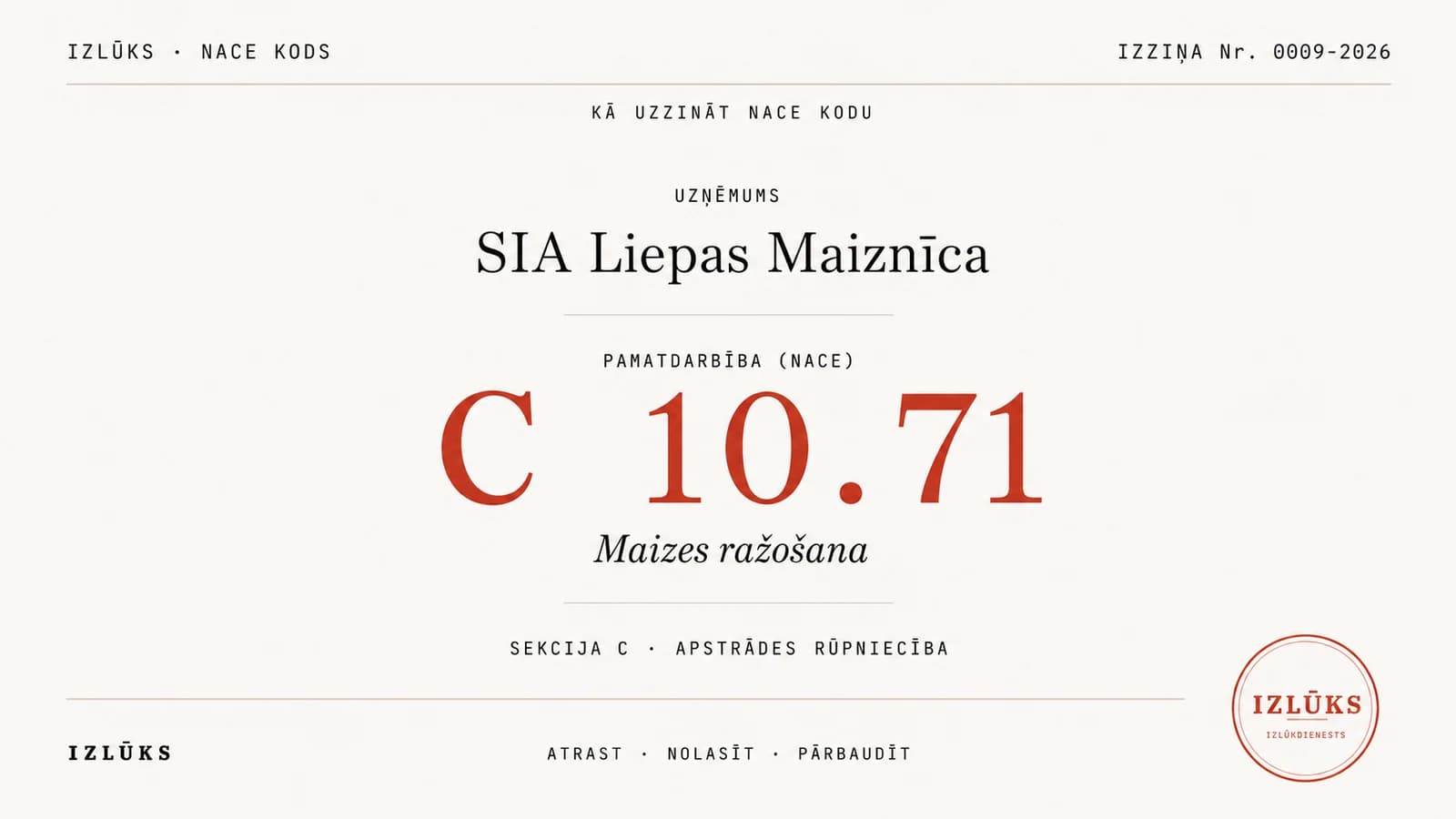
A company's NACE code is one letter and four digits that mark its principal activity, and it can be read straight from public register data. Finding it is easy; the harder part is knowing whether the code still matches what the company actually does.
A company's NACE code appears in the business register's open data, or on its profile in a commercial data service. It is the main-activity type the company declared to the State Revenue Service (VID), and its notation is simple: a letter and four digits, for example G and 47.11. Looking it up is free and needs no cooperation from the company: it is part of the public register record.
Where to find a company's NACE code
For a specific company, the declared code sits in the business register's open data (Uzņēmumu reģistrs) and in commercial data services, next to the name, address and registration number. On a company profile it usually appears with the section and division names, so the digits and their meaning are visible together. Because the data is public, you can look up a counterparty's code knowing only its name or registration number. To check many companies at once, the open data can be downloaded in bulk and codes read off a whole list, not one at a time.
A company's owner or accountant sees its own code in the State Revenue Service's electronic declaration system, which is also where it is changed when the main activity changes.
To go from a code to its meaning, or from an activity to the right code, the Central Statistical Bureau (CSP) runs a classifier look-up.1 It can be searched by the code or by a keyword in the activity description, and shows each code's meaning from section to class.
How to read the code
A code reads from broadest to narrowest. Take MAXIMA Latvija (registration number 40003520643): its declared code is 47.11, in section G.2
G— section: wholesale and retail trade;47— division: retail trade;47.1— group: retail sale in non-specialised stores;47.11— class: retail sale predominantly of food, beverages or tobacco.
The letter marks a whole industry; each further digit narrows it. Code 47.11 reads as an ordinary grocery shop: trade, retail, non-specialised, food. The code's four-level structure, and how the letters shifted in NACE Rev. 2.1, are covered separately; here it is enough to know that the more digits, the narrower the description.
Going the other way, from an activity to a code, the path is the same in reverse: from the section that covers the industry down to the class that describes the specific activity. Each code's classifier entry lists what it includes and excludes, so borderline cases can be resolved.
A company declares a single main-activity code even if it operates across several fields; the principal activity is the one with the largest share of turnover. So the code you find shows the main activity, not everything the company does.
How to check the code is current
The code you find shows what the company declared, not necessarily what it does today. The main-activity type is reported by the company itself; if the activity changed in the previous year, the code must be updated by 1 May.3 So even a timely update describes the previous year's activity, not today's. A code chosen at registration and never changed since can lag reality.
A second code exists. The Central Statistical Bureau determines a company's activity type on its own — from surveys, annual reports and other sources — and it may differ from the one declared to VID.4 So one company's code can disagree across sources.
A mismatch is often harmless: a company first declared wholesale, moved into manufacturing, but never updated the code. For an analyst this means the sector cannot be read from the declared code alone. The simplest check is to compare the code against what the company actually does: its revenue mix, headcount, the industry averages. In Latvian company data, around 158,000 companies are classified by activity using tax data;5 their breakdown by section and division can be viewed in the industry overview to see whether the declared code matches the sector picture.
A NACE code places a company in an industry and lets it be compared with peers; it is a starting point, not an endpoint. Whether the declared code matches reality is shown more reliably by the numbers behind it: turnover, headcount, position within the sector.
Notes
Footnotes
-
Classifier look-up and code explanations — Central Statistical Bureau (CSP; csp.gov.lv), NACE Rev. 2.1. ↩
-
MAXIMA Latvija (reg. no. 40003520643), declared NACE code 47.11 (2024 classifier version). Latvian company data, extract 2026-07-02. ↩
-
Reporting of the main-activity type to the State Revenue Service (VID) and the duty to update the code by 1 May where the main activity changed in the previous year — law "On Taxes and Duties", Section 15(1), point 15. The main activity is the one with the largest share of total turnover. Source: VID (vid.gov.lv). ↩
-
The Central Statistical Bureau notes that the economic-activity type reported to VID may differ from the one the Bureau determines; it determines the type from statistical surveys, annual reports and other sources. Source: csp.gov.lv. ↩
-
Around 157,805 Latvian companies (active and closed) are classified by activity type on the basis of VID tax data; extract 2026-07-02. The figure differs from the total number of companies in the register, because not every register entry has a determinable economic activity. ↩