A company's filed financial statements can now be downloaded as an XLSX or CSV file: the profit and loss account, the balance sheet and the cash flow statement where one was filed. For every year the file names, the currency and the report scope, and where a figure was never reported, the cell stays empty.
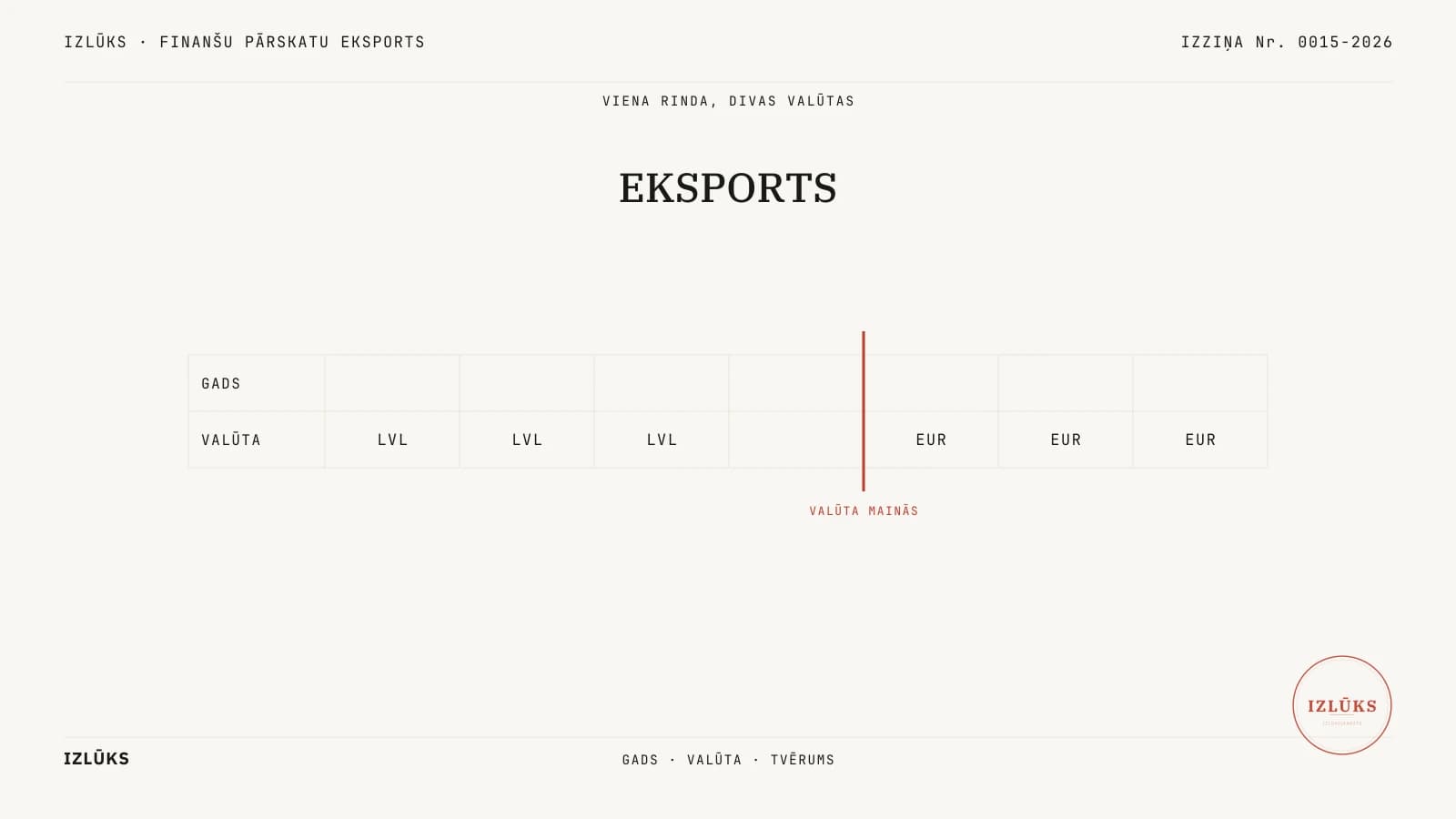
Between 2008 and 2025 Latvenergo (40003032949) filed twelve financial statements, not eighteen: 2010 is missing, and so is every year from 2012 to 2016. The three oldest are in lats.1 One company, and already three separate places where a hand-copied time series goes wrong: a missing year, a changed currency, a different reporting scope. The exported file shows each of them in that year's column.
What is in the file
The XLSX file holds several worksheets. The first is a summary: for every year the currency, the report scope, the report type and the number of employees, and beneath them four headline rows — revenue, net income, total assets and equity. After it comes one worksheet per filed statement. Their rows are the ones the finances section shows, so the downloaded file reads exactly the same way.
In the file the years run from oldest to newest; in the section itself the order is reversed, with the newest year first. That is not a defect: a time-series chart is drawn left to right, so a chart built from columns in reverse order would show the history backwards.
The CSV is the same content in a single file. There the summary and the statements are named blocks stacked one below another, all under the same year axis. Values are raw numbers without formatting. The file opens with a byte order mark so that Excel on Windows reads Latvian characters correctly; a tool that does not expect one should strip it before parsing.
Currency and scope sit above every column
Two rows repeat at the top of every worksheet, not only on the summary: currency and report scope. The reason is arithmetic.
Latvenergo's revenue for 2011 is 700,913,823 in the filing — in lats. For 2017 it is 925,627,000 euro. The file converts nothing: a figure stays in the currency it was filed in. Anyone who puts the two columns in one row without noticing the currency sees growth of almost a third. At the fixed conversion rate the 2011 revenue is roughly 997 million euro,2 so between those two years turnover in fact fell. The file does not do that conversion, and the currency row is the only sign that it is needed.
The report scope answers the second question: how far that year's statement reaches. A consolidated statement covers the subsidiaries as well, a standalone one only the company itself. Put in one row, they show two different companies. There is one caveat here. Where the registry data carries no report-type code for a year, the file shows that year as a standalone statement; Latvenergo's lats years have no code, so the scope there is an assumption rather than a filed fact. It can be checked in the same place: the report-type row is empty in those years.
Each statement has its own worksheet, and the balance sheet can be opened without ever seeing the summary. That is why both rows sit on every worksheet rather than on one.
An empty cell is not a zero
Where a line item was not reported in a given year, the cell stays empty. No zero is written in its place. A line item that was not reported and a line item reported as zero are two different facts, and wherever an average or a percentage change is computed from the column, the difference changes the result.
The same holds for a whole statement. If no exported year filed a cash flow statement, that worksheet is not in the file — there is nothing in place of an empty sheet. This is not unusual: the law requires a cash flow statement of medium and large companies and does not require it of small ones.3
With reported zeros the file does the opposite. Rows reported as zero in every exported year do not appear at all, just as the finances section does not show them; the full annual report, where one is available, stays in the documents section. And in the cash flow statement the two net sums — for investing and for financing activities — are often zero or empty in the registry data. The file then adds them up from the section's line items and marks the row with an asterisk.
How many years, and at what price
The export is free and spends no credits. There is one condition — a signed-in session; a visitor who is not signed in does not get the file.
A free account gets the three most recent filed years, a subscription all of them. The largest companies are the exception: those in the top fifty by revenue, by assets or by employees are open without a subscription, so a free account gets the full history there too. Latvenergo is one of them, and its file holds all twelve years.4
The oldest annual reports available in the register are from 2006, so in practice the file does not reach further back. How deep it will go is visible before the format is chosen, not after the download.
The file name carries the registration number and the date the file was generated, and that same date appears on every worksheet. A month later it is the only thing that says which day the figures belong to.
Notes
Footnotes
-
Latvenergo (reg. No. 40003032949) filing history in Izlūks data; extract 2026-08-08: twelve financial statements between 2008 and 2025. 2010 is missing, as is every year from 2012 to 2016. The statements for 2008, 2009 and 2011 were filed in lats (LVL), Latvia's currency before it adopted the euro in 2014. ↩
-
The fixed conversion rate is EUR 1 = LVL 0.702804 — Council Regulation (EU) No 870/2013 of 9 July 2013. At that rate LVL 700,913,823 is roughly EUR 997,310,520. The exported file does not carry this conversion — both figures stay as they were filed. ↩
-
Section 9(2) of the Law on Annual Financial Statements and Consolidated Financial Statements (in Latvian, Gada pārskatu un konsolidēto gada pārskatu likums) provides that the financial statements of a medium or large company also include a cash flow statement and a statement of changes in equity. Section 9(1) requires the financial statements of a small company to consist of at least a balance sheet, a profit and loss account and the notes — those two statements are not required of it, though preparing them is not barred. Under Section 5(2) a micro company is a kind of small company. ↩
-
Export depth by account: a free account gets the three most recent filed years, a subscription every filed year. The full history is also open without a subscription on freely accessible companies: the top fifty by revenue, the top fifty by assets and the top fifty by employees. The export is free of charge and spends no credits; the only condition is a signed-in session. The rule is set out in the frequently asked questions as well. ↩