Over six years, EU money to Latvia changed colour: the defence share rose from zero to roughly a quarter. Inside the companies, most of the money stays in the supply chain — but the leak is concentrated in one place.
In January 2026 the European Commission approved Latvia's SAFE application for €3,497M. The first tranche — €524M — will reach the state treasury this year. That is roughly what Latvia drew from the Cohesion Fund in an average year of the 2014–2020 period.
It is a loan, not a grant. The money will arrive in the state treasury; it will reach companies only when the Ministry of Defence spends it through procurement. SAFE is the most recent layer in a three-layer flow. The other two — the national defence budget, which over six years has grown from €758M (2.2% of GDP) to €2,158M (4.7%), and the direct EU grants, EDF and ASAP, which add small but steadily rising amounts.
The defence line's share in the total EU flow to Latvia changes unevenly:
| Year | Total EU flow | Defence share |
|---|---|---|
| 2020 | ~€1.1bn | ~0% |
| 2022 | ~€1.3bn | ~0.4% |
| 2024 | ~€1.0bn | ~8% |
| 2026 (plan) | €2.5–3.0bn | ~25–35% |
The 2026 jump comes almost entirely from SAFE. Without it, Latvia's defence line in the EU flow would stay at around 5–10% — more than in 2024, but not in a qualitatively different bracket.
The third layer consists of several smaller channels: the CEF military mobility window through Rail Baltica and airport projects, the February 2025 restructuring of the Recovery and Resilience Facility with nearly a quarter of the envelope redirected to defence lines, and EDF direct grants to industry. Individually, modest amounts; together, more than ten channels that did not exist in 2020.
For thirty years Latvia was a convergence recipient from the EU: the money came to narrow the income gap. The EDF was established in 2017 but only begins to register on Latvia's balance after 2022. The last thirty-six months are the first period in which EU programmes — formally or through restructuring — begin to name defence as their purpose.
Inside the companies
The first view outside the state treasury comes from the companies themselves. In Izlūks data on 33 Latvia-registered defence-industry companies whose annual reports are available in the register, an average of 78 cents of every revenue euro in 2024–2025 went to cost of goods sold: supplies, materials, production wages. The remainder splits between administrative expenses and profit — but the proportions differ when sliced by ownership.
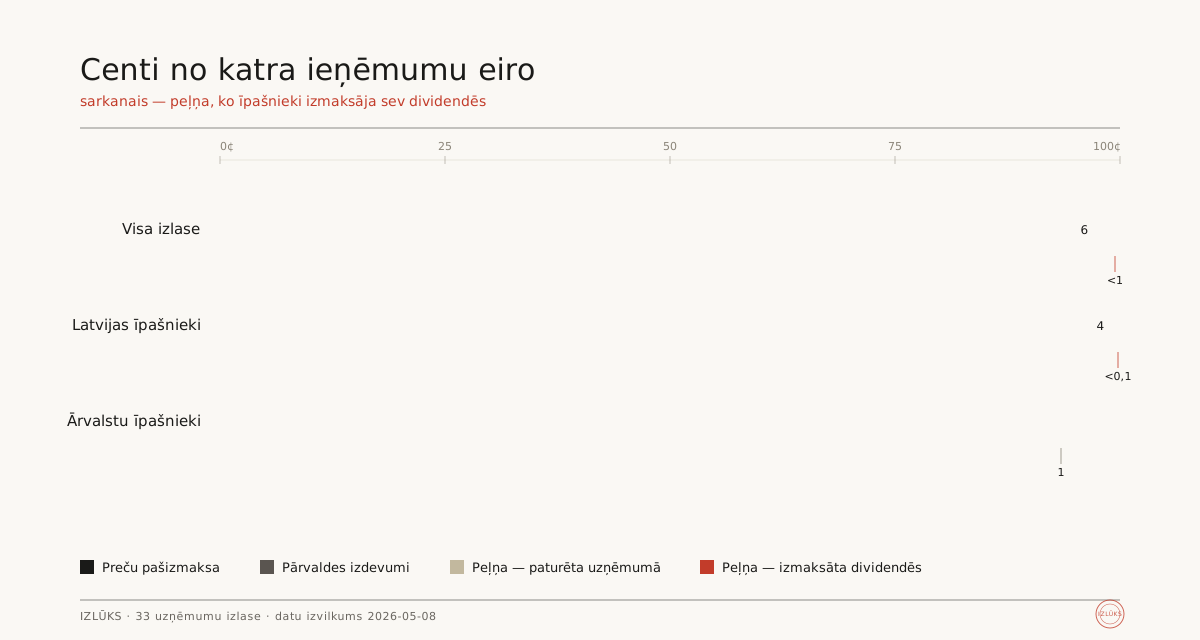
Among Latvian-owned firms the largest are UPB (€219.4M group-level revenue in 2024, part of which is defence-infrastructure work for Ministry of Defence orders), HansaMatrix (€36.1M), Valpro (€29.8M) and Belss (€18.4M) with its subsidiary Eraser (€6.0M, 2025). Among foreign-owned firms — Edge Autonomy (€68.3M) and EMJ Metāls (€26.2M, subcontractor for Patria 6×6 hulls).
Across the sample, of €56.6M in net profit, €7.25M was paid out as dividends. The remaining €49.3M stayed in the companies — as equipment investment, as working capital, as wages for new staff.
This small leak is not evenly distributed. Of the €7.25M in dividends, €6.72M — 93% — left a single company: SIA Edge Autonomy Riga (now registered as Redwire Defense Tech Riga SIA) flowing to its US parent. That is 70% of the SIA's 2024 net profit. The next largest line — €500k from AS Valpro to its Latvian holding companies. The remaining 31 companies paid €30k in dividends combined, or nothing.
This is a recent picture. In the last eighteen months, four Latvia-registered defence firms have changed owner to a foreign company: Edge Autonomy (US, 2025-06), Lightspace Technologies (Finland, 2024-12), Ammunity (Sweden, 2025-11), Atlas Aerospace (Israel, 2026-02). Together they reported €79.6M in revenue across their 2024–2025 annual reports. Edge Autonomy is the only one that has reached a steady dividend-payout regime after acquisition; the other three are still in the consolidation phase.
Two figures deserve following.
The first is small but rising: the three recent acquisitions — Lightspace, Ammunity, Atlas Aerospace — are still in the consolidation phase. In two to three years their profit-payout pattern is likely to resemble Edge Autonomy's. At that point the profits of these companies will also begin to flow out to parent companies outside Latvia — adding further millions to today's €6.72M.
The second is large and dormant: LMT. In 2025 the company reported €333.8M in revenue and €33.4M in net profit; dividends — zero. 49% of LMT shares belong to Sweden's Telia group. If in any year Telia for the first time demands its share of LMT's accumulated profit, that single decision will push an outflow from Latvia exceeding everything observed to date by an order of magnitude.
The colour is set in Brussels. The other end of the money is decided in Latvia and Stockholm.